Hello {{ name | there }},
Ever wonder why some relationships just click—leaving you feeling energized, seen, and understood while others feel like friction?
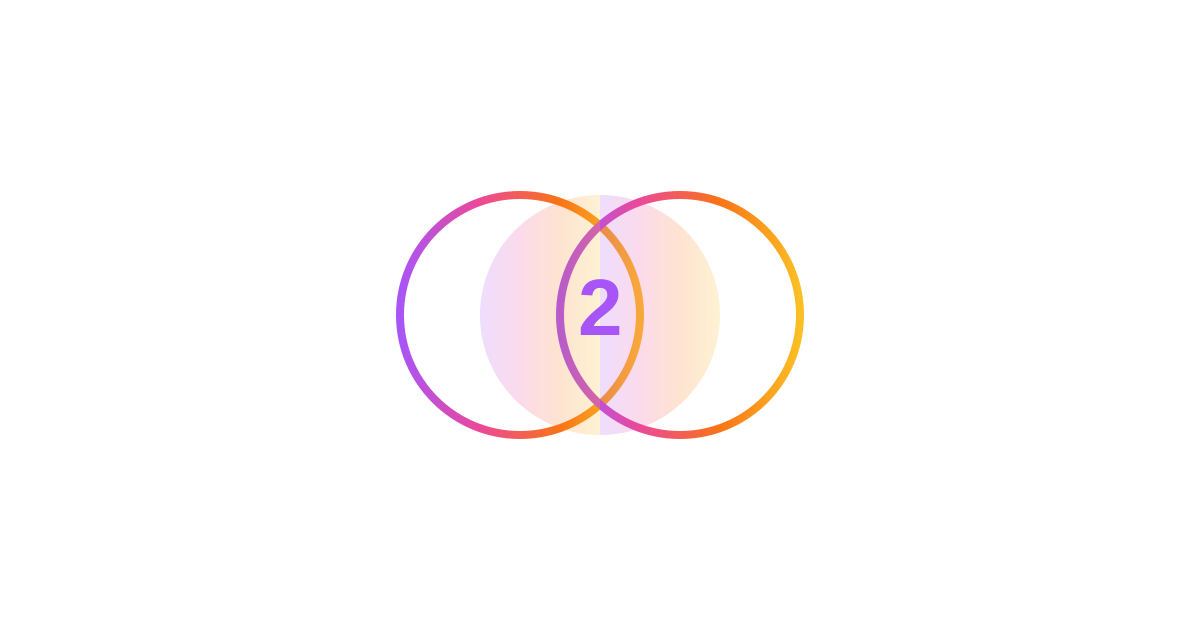
In this issue, I’m introducing the Power of Two, a core relationship concept from my book Modern Compass. It’s a simple lens for understanding how resonance forms in our relationships.
You’ll see why this matters across all kinds of relationships, plus get a couple of quick activities to help you spot what creates resonance for you.
Want to listen to an overview of this issue on the go? Check out this TikTok video: @themoderncompass #moderncompass #newsletter #relationships
Featured Insight: Relationship Resonance and the Power of Two
Let’s start with how I define resonance in relationships:
Resonance emerges when empathy is reciprocated, presence is mutual, and energy flows without friction. It’s not loud or urgent. It’s a quiet harmony—something you feel when connection finds a natural rhythm.
Resonance isn’t just for romantic relationships as I alluded to, it shows up everywhere and in all relationships, family, friends, and colleagues too.
Before we move on, it’s helpful to think about two levels of resonance:
- Personal resonance: When you feel connected to someone, even if it’s not fully returned.
- Shared resonance: When both people feel it—mutual empathy, aligned energy, and effortless presence.
Key distinction: It’s common to feel personal resonance with public figures, authors, content creators, etc when their message or actions align with you. That type of resonance is always one sided unless you know the individual. What we will focus on going forward is shared resonance, that can only form through mutual presence and real interaction.
The Power of Two is really a simplified way to understand what builds resonance in relationships. It’s made up at a minimum of these 2 things:
- Common Ground — shared interests, context, or experiences
- Discovered Character Alignment — a revealed sense of shared values, consistent behaviors, or a similar way of showing up
Common Ground shows who they are. Discovered Character Alignment reveals how they act. Together, they help you decide not just who you enjoy—but who you can rely on. In the past many folks say it’s common ground and shared values, but we can say we value something, and act differently. That’s how discovered character alignment through time together is more revealing than shared values. Most of us also have a hard time assessing someone’s values, but they can observe behavioral congruence.
Power of Two isn’t saying only two matter—it’s asking whether you can name those two.
Common Ground examples:
- Grew up in the same region or cultural background
- Shared interest in a specific hobby or topic (e.g. cycling, philosophy, personal growth)
- Similar life stage (e.g. both new parents, both navigating a career pivot)
Discovered Character Alignment examples:
- Both have pride in their work or craft
- Both value deep conversation over surface-level talk
- Both show generosity without expecting recognition or return
These are the 2 key elements that make up resonance in a relationship. Now you might be thinking within one of your relationships, well there are 5 things we have common ground on and 3 ways we have character alignment. To that, I’d say there’s really no issue with that, but it might be worthwhile to consider, what would they be if you had to pick 2. More on that type of activity later down in the modern tools section.
Important to note, the mere fact of noticing those 2 things doesn’t guarantee mutual resonance, but it tells you a connection may be worth paying attention to. From there, you can look for signs that resonance is shared—not just something you’re experiencing on your own.
Shared resonance often reveals itself gradually—through mutual curiosity, presence, and reciprocal effort. While we never know exactly what someone else is feeling, you can observe patterns or ask subtle questions that surface alignment, especially around character.
Here are two prompts per relationship type that can help you surface shared resonance:
Family
- “When do you feel most at ease around people in our family?”
- “Who in the family really gets how you operate—and why do you think that is?”
Professional
- “What kind of working relationships or team mates bring out your best?”
- “When collaboration feels easy, what do you think makes that possible?”
Friend
- “What do you value most in your close friendships?”
- “What makes you feel like someone’s your kind of people?”
Intimate
- “What are your two strongest signs that a connection is resonating for you?”
- “When you feel deeply connected to someone, what’s usually happening between you?”
Quick side note for married couples: Even if you’re married and have been for some time, this was a fun conversation when I mentioned to my wife what I thought those 2 things were for me when we started dating and hearing what 2 things were for her.
These prompts aren’t about testing anyone, they’re about understanding how the other person experiences your connection.
If their answers reflect the same common ground or character alignment you’re sensing, there’s a strong chance the resonance is mutual and worth further investing in.
Why Understanding Resonance is Beneficial
Whether you’re exploring new romantic connections, strengthening professional relationships, or wondering if it’s time to let a few go, Resonance and the Power of Two gives you a practical lens. Like the old saying goes, knowing is half the battle, in this case knowing is understanding how to spot developing resonance. The other half here is choosing with intention, investing in the relationships that align, letting go of the ones that don’t, and having language to explain why.
Personal Anecdote
When I prompted this activity with my wife recently, discussing what my 2 were during our dating days, I came up with the following:
Common ground - shared interest in nerdy topics. Harry Potter, Disney (totally not nerdy by the way), Legos, etc
Discovered Character Alignment - Both of us not only had deep family roots in Texas, we also discovered neither of us would ever move away from family. Going back to this isn’t just a shared values thing, I saw her view and love for family in every interaction over the first several weeks/months that aligned with how I view family. We’ve been building on that foundation and others ever since.
Activity: Scroll & Spot What Resonates
You’re already scrolling—why not turn it into insight? This quick activity uses your favorite social feed to help you practice noticing resonance in real time. It’s a low-stakes way to sharpen your awareness of what draws you in… and why.
- Open Your Favorite Social Media App: TikTok, Instagram/Facebook Reels, YouTube Shorts, or any platform you like with short form videos from people you don’t know.
- Swipe Until Something Resonates: Scroll through the content and pay attention to when you feel the urge to stop and watch.
- Reflect on the Why: Ask yourself what made you pause. Was it the topic, the style, the person, or something else?
- Identify the Resonance: Take a moment to note what specifically resonated with you and why it stood out.
- Apply the Insight: Think about how recognizing what resonates in small moments can help you understand what truly matters to you in bigger decisions and relationships.
Activity: The Power Pair Reflection
On your next walk, commute, or break, try this quick mental exercise to help you recognize what creates resonance for you in relationships.
- Pick a relationship. Choose one that’s been on your mind—friend, colleague, or partner. (Skip parent/child for this one.)
- Name the connection. Identify one clear point of common ground (what you share) and one discovered character alignment (how they show up in a way that resonates with you).
- Notice what clicks. Pause and reflect: What do these two things tell you about what makes a relationship feel real, energizing, or easy for you?
- Bonus step: use one of those prompts above and bring one of them up in any 1 of your relationships. You just might learning something new
I’d Love Your Thoughts
I’d love to hear what resonated (see resonance shows up a lot, and you might be sick of that word by now) or where you’re still unsure. Whether this is your first issue or you’ve been here since the beginning, your feedback helps more than you may know.
Further more, if there is a sticky spot within this concept, something that felt hard to grasp or apply—hit reply and let me know. I have plenty more written on this topic within the book and currently working to finish the 1st pass of it, maybe I can give you a bit more than what’s here, or shed more light on a new perspective I hadn’t seen or considered.
🥳 Modern Compass Digital Asset Store Launch 🥳
I have launched a Modern Compass digital asset store on Etsy this past week and just being a Newsletter subscriber, grants you 30% off code that lasts until end of July.
These are the 2 digital assets I currently have on Etsy. Feel free to take a look and reply with any feedback of the listing and/or digital asset. Your feedback is always a gift!
- Break the Loop - Get Unstuck in Under 10 Minutes
- Overwhelm Reset - Braindump Worksheet with a twist to enable more deep thought
A minor detour on why I went down this path. A) Several of these newsletters have been digital asset adjacent (needing a little more something structured activity or desired outcome), and B) operating scrappy startup style (common phrase used in Tech companies) digital asset income is a means to put more into ads and boosting growth. This activity forced me to update my logo from a generic compass for more polish, so it was a win just for that!
Interesting Finds
Credit to Google Gemini on these
1. AI-Designed Cancer Drugs Nearing Human Trials
The Find: Isomorphic Labs, Google DeepMind’s AI drug discovery firm, is preparing to launch human trials for its AI-designed cancer drugs. This is a groundbreaking moment, as these drugs were conceived and optimized by artificial intelligence, potentially transforming the speed and precision of future medical breakthroughs.
Why it’s cool: This isn’t just about faster drug development; it’s a validation of AI’s ability to innovate in complex fields like medicine, potentially leading to more effective and targeted treatments for various diseases.
2. The Month of July’s Roman Makeover
The Find: The month of July was originally called “Quintilis,” meaning “fifth month,” in the ancient Roman calendar. In 44 BC, it was renamed “July” in honor of Julius Caesar, who was born in that month.
Why it’s cool: It’s a fascinating historical tidbit that highlights how the legacy of powerful figures continues to shape even the most mundane aspects of our modern lives, like the names on our calendars.
Stay Connected and Always…Follow Your Compass
Like this issue? Share it with a friend who’d enjoy it!
Subscribe here: Newsletter Signup Link